James George Barbadoes (c. 1796–June 22, 1841) was an African-American, community leader, and abolitionist in Boston, Massachusetts in the early 19th century. Dedicated to improving the lives of African-American people at the local level, as well as the…
James Henry Harris (c. 1832–1891) was an American upholsterer and politician. Born into slavery, he was freed as a young adult and worked as a carpenter's apprentice and worker before attending Oberlin College in Ohio. For a time, he lived in Chatham,…
James Hemings (c. 1765–1801) was the first American to train as a chef in France . Three-quarters white in ancestry, he was born into slavery in Virginia in 1765. At eight years old, he was purchased by Thomas Jefferson at his residence of Monticello.
James Jakob Williams (Greek:Τζέιμς Τζέικομπ Γουίλλιαμς; 1785/1800–1829) was an African-American runaway slave and soldier. He took part in the Second Barbary War as a member of the US Navy and later alongside the Greek revolutionaries during the Greek War…
James Lewis (c. 1832 – July 11, 1914) was an African-American soldier and politician in Louisiana. Born into slavery and of mixed race, during the American Civil War he left a position as steward on a Confederate steamboat to move to New Orleans, which had…
James Milo Alexander (February 7, 1815 – May 27, 1871) was an African-American businessperson and politician in Phillips County, Arkansas. Alexander was a successful businessperson and the first African-American justice of the peace in Arkansas. Born into…
James M. Dickson, sometimes written as James M. Dixon, was a minister, farm owner, and state legislator in Mississippi. He was enslaved from birth. He represented Yazoo County in the Mississippi House of Representatives in 1872 and 1873. He also served as…
James Mux Priest (July 8, 1819 – May 16, 1883) was the sixth vice president of Liberia from 1864 to 1868 under President Daniel Bashiel Warner. He was born enslaved in the U.S. state of Kentucky. Slaveowner Jane Anderson Meaux educated and freed Priest and…
James Merilus Simms (December 27, 1823 – July 9, 1912) was a minister, newspaper publisher, author, and elected representative in the Georgia Assembly during the Reconstruction era. He was African American. Simms was born a slave in Savannah, Georgia.
James Madison Bell (April 3, 1826 – March 4, 1902) was an African-American poet, orator, and political activist who was involved in the abolitionist movement against slavery. He was the first native African-American poet in Ohio and was called the "Bard of…
James Mars (March 3, 1790 – May 27, 1880) was an American slave narrative author and political activist. Born into slavery in Canaan, Connecticut, he gained his freedom in 1811. In 1864, he published his memoir A Life of James Mars, a Slave Born and Sold…
Unable to study medicine in the U.S., Smith earned his degree at the University of Glasgow and became a leading physician, writer and abolitionist in New York.
James Monroe Gregory (January 23, 1849 – December 17, 1915) was an American professor of Latin, and dean at Howard University. During the American Civil War, he worked in Cleveland for the education and aid of escaped slaves. He initially attended Oberlin…
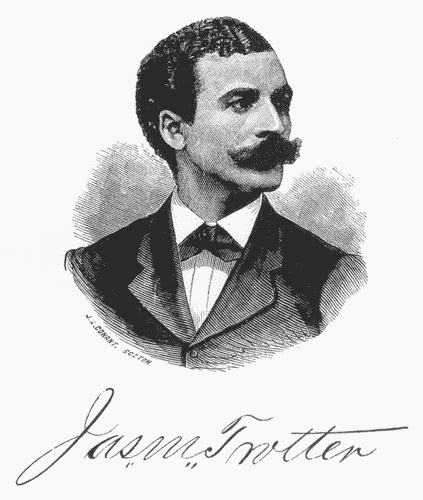
James Monroe Trotter (February 7, 1842 – February 26, 1892) was an American teacher, soldier, employee of the United States Post Office Department, a music historian, and Recorder of Deeds in Washington, D.C. Born into slavery in Mississippi, he, his two…
James Monroe Whitfield (c. April 10, 1822 – April 23, 1871) was an African-American poet, abolitionist, and political activist. He was a notable writer and activist in abolitionism and African emigration during the antebellum era. He published the book…
James Nathan Calloway (1865 – after 1930) was an American agriculturalist. Born in slavery in Tennessee, Calloway graduated from Fisk University before joining the faculty of the Tuskegee Institute. Initially a lecturer in mathematics, he became involved…
The Reverend James Newton Gloucester was an African-American clergyman and businessman who was a supporter of abolitionist John Brown. Like his father, Gloucester was a Black Presbyterian pastor. In 1849 he founded Siloam Presbyterian Church. He and his…
James Preston Poindexter (October 26, 1819 – February 7, 1907) was an abolitionist, civil rights activist, politician, and Baptist minister from Columbus, Ohio. He was born in Richmond, Virginia and moved to Ohio as a young man. In Ohio he was a part of…
James Newby (c. 1843 – after 1884) was an American Civil War veteran who served in the first regiment of volunteer African Americans in the United States and a 19th-century African-American missionary to present-day Nigeria, Cameroon, and Liberia.
James E. Ransome (born September 25, 1961) is an American illustrator of over 60 children's books. He has also illustrated greetings cards and magazines, and has been commissioned for murals, including three for the National Underground Railroad Freedom…
Rev. James Robinson (March 21, 1753 – March 27, 1868) was an American preacher and soldier who served during the American Revolutionary War. Born into slavery on the Eastern Shore of Maryland in 1753, Robinson later became a minister and was remembered for…