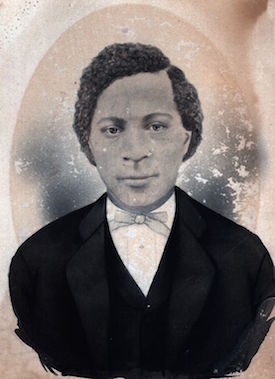
Henry Demas (April 16, 1848 – April 19, 1900) was an enslaved African American who became a constable, state legislator, civil rights activist, and organizer of Southern University in Louisiana during the Reconstruction era.
Henry Eppes (September 16, 1830 or 1831 – January 26, 1903) was an American politician and minister. Despite being born into slavery, he served seven terms in the North Carolina Senate and also served as a delegate for Halifax County to North Carolina's…
Henry Floyd Gamble (16 January 1862 – 7 September 1932) was an African-American surgeon, obstetrician, physician and president of the National Medical Association from 1911 to 1912. Gamble was born on 16 January 1862 in North Garden, Virginia to Henry…
Henry Highland Garnet (December 23, 1815 – February 13, 1882) was an American abolitionist, minister, educator, orator, and diplomat. Having escaped as a child from slavery in Maryland with his family, he grew up in New York City. He was educated at the…
Henry Hunter Craig (died 1876) was an American grocer, barber and politician who represented Montgomery County, Alabama in the Alabama House of Representatives from 1870 to 1872. Henry Hunter Craig was born enslaved in the state of Virginia, United States.…
Henry O. Wagoner (February 27, 1816 – January 27, 1901) was an abolitionist and civil rights activist in Chicago and Denver. In the 1830s, as a free black man in Maryland, he worked on a farm and worked to free slaves with a loose group of individuals that…
Henry Ossian Flipper (March 21, 1856 – April 26, 1940) was an American soldier, engineer, former slave and in 1877, the first African American to graduate from the United States Military Academy at West Point, earning a commission as a second lieutenant in…
Henry P. Jacobs (July 8, 1825 – December 14, 1899) was an American politician and educator. Jacobs was born in Alabama. He escaped slavery to Canada and then moved to Michigan before settling in Natchez, Mississippi after the American Civil War.
Henry P. Scott was a grocer, farmer, sheriff, tax collector, and state legislator in Mississippi. He was born in Mississippi and enslaved at birth. He was a delegate to the 1865 Mississippi black convention at Vicksburg. He was elected to represent…
Henry Proctor Slaughter (September 17, 1871 – February 14, 1958) was an American journalist, printer, and bibliographer. Slaughter collected resources that documented African American history, with a special focus on the subjects of slavery, the…
Henry S. Sneed, last name sometimes spelled Snead, was enslaved before becoming a farmer and state legislator in Texas. He was elected to the Texas House of Representatives in 1876 from Waller County, Texas, Wharton County Texas, and Fort Bend County,…
Hercules Posey (c. 1748 – May 15, 1812) was an enslaved African American held at George Washington's plantation Mount Vernon in Virginia. "Uncle Harkless," as he was called by a grandson of Martha Washington, served as chief cook at the Mansion House for…
Hester Lane (died 1849) was an American abolitionist, philanthropist, entrepreneur, and political activist. Born into slavery in Maryland, she settled down in New York as a free woman. Lane was known in New York for her approach to adding color pigment to…
Amy Hester "Hetty" Reckless (c. 1776–1881) was a person who liberated herself from slavery and became part of the American abolitionist movement. She campaigned against slavery and was part of the Underground Railroad, operating a Philadelphia safe house.
Hezekiah Ford Douglas (c. 1831 – 11 November 1865), commonly known as H. Ford Douglas (often spelled "Douglass" on government documents and in newspapers), was an abolitionist who promoted African-American emigration. He was a traveling speaker, political…
Hezekiah Grice (c. 1801 – 1863) was an American and Haitian activist, machinist, and businessman, noted for his political activity in Baltimore during the early 19th century. While working as a machinist in Baltimore, he was either the first person or one…
This doll was handmade by Obadiah Beverly, known as Obe, a formerly enslaved man in Virginia. The doll is composed of a hickory nut, wooden stick, fabric and lace. The nut, used for the head, is wrapped in a section of faded cotton cloth, with part of the…
Smithsonian National Museum of African American History and CultureCatalog 2016.57
Hiram Young (c. 1812—January 22, 1882) was an African-American freed slave from Tennessee who became one of the leading manufacturers of wagons for the Oregon Trail. In the mid-19th century, his business was located at the eastern origin of the trail in…
A hiring agreement for an enslaved woman named Martha in South Carolina. The small, single sheet and page document is on yellowed paper with black preprinted and handwritten text. The document represents the hire of an enslaved woman named Martha to…
Smithsonian National Museum of African American History and CultureCatalog 2018.43.5
The Papers of the DeWolf Family shed light on one of the wealthiest New England families in the 18th-19th centuries who made their fortune by engaging in each part of the transatlantic slave trade. This collection is comprised of photographs,…
Smithsonian National Museum of African American History and CultureCatalog A2018.17.2
A documentary series with the title History of the Negro in America. It consists of three (3) reels of black-and-white 16mm acetate film with optical sound. Each film has a different focus and title. The first film (part 1) is titled "1619-1860 Out of…
Smithsonian National Museum of African American History and CultureCatalog 2017.55.24.1abc
A hardback book (a), the History of the Negro Race in America From 1619 to 1880, owned by Rev. Amos Brown. This is the first popular edition, which combines Volume 1: 1619-1800 and Volume 2: 1800-1880 into a single book. In addition to providing a…
Smithsonian National Museum of African American History and CultureCatalog 2025.37.2abc
A shorter handcarved wooden handle with metal flat hoe head, used as a small hoe. Handle is a grayish -medium wood, that tapers to a point at the end opposite the axe head, with a ball/circle on the end with a indention around the circumfrance between the…
Smithsonian National Museum of African American History and CultureCatalog 2014.312.17

 Loading image…