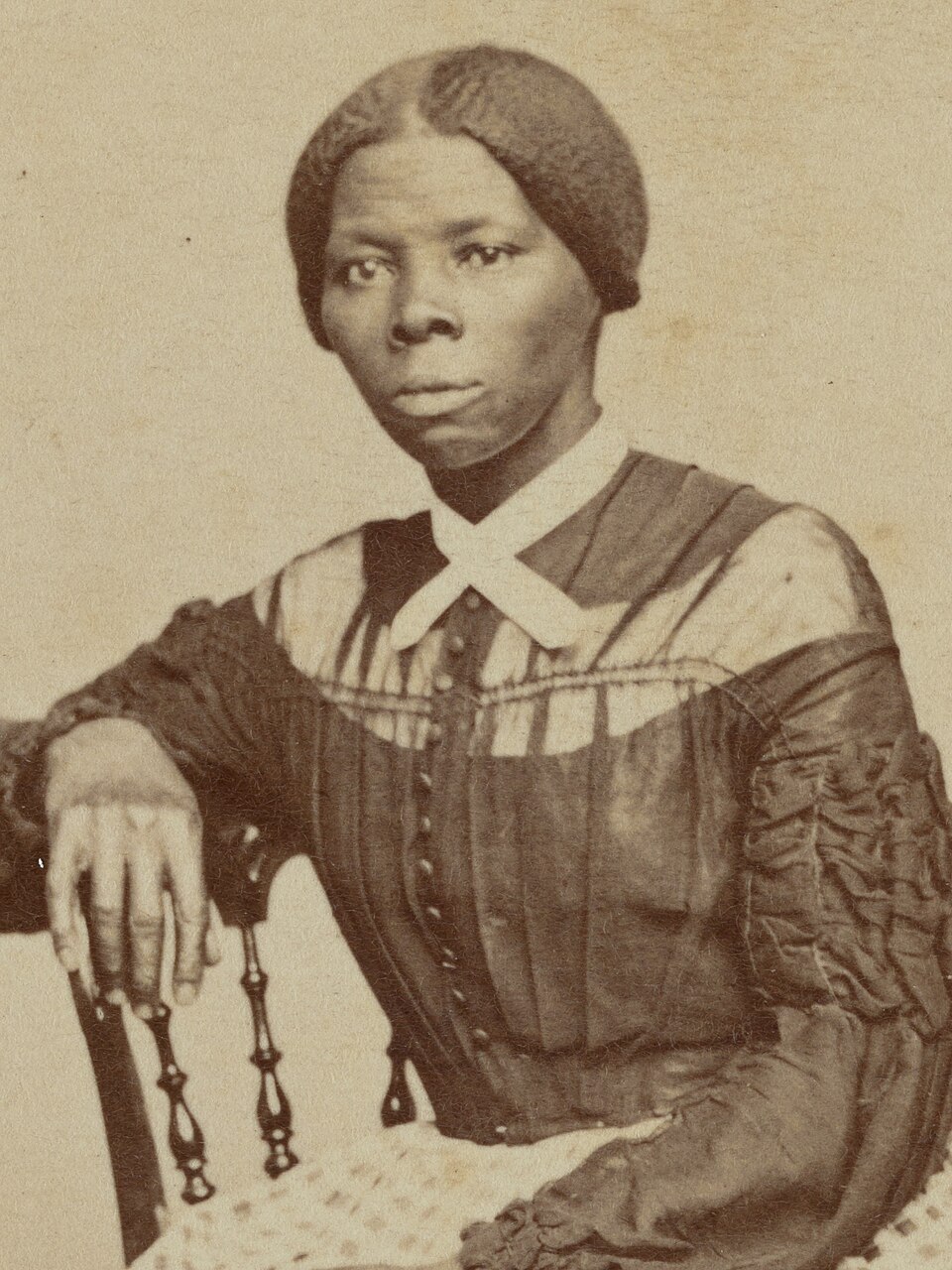
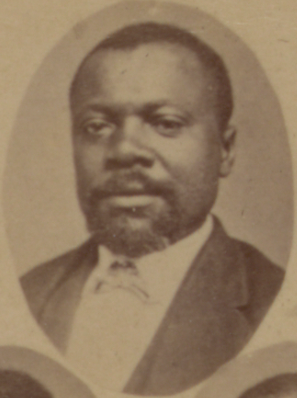
Harriet Powers (October 29, 1837 – January 1, 1910) was an American folk artist and quilter born into slavery in rural northeast Georgia. Powers used traditional appliqué techniques to make quilts that expressed local legends, Bible stories, and…
Harriet Purvis Jr. also known as Hattie Purvis (c. 1839 – 1904) was an African-American abolitionist, suffragist and a member of the temperance movement. She was part of the second generation of American suffragists. Purvis worked closely with Susan B.…
Harrison Barrett (c. 1845—1917) was a former slave born in about 1845 to slave parents from Louisiana, Simon and Eliza Barrett. He had two brothers and two sisters.
Harrison H. Truhart. (b. about 1840 Virginia - 1912) was a blacksmith and state legislator in Mississippi serving as a representative from 1872 to 1875. In 1872 he was elected to the Mississippi House of Representatives to represent Holmes County,…
Harry Washington (c. 1740–1800) was a Black Loyalist in the American Revolutionary War, enslaved for a time by Virginia planter George Washington, later the first President of the United States. After the British lost the war, he was evacuated to Nova…
A black-and-white photograph depicting a brick chimney that is all that remains of a rice mill. The chimney appears on the right side of the image in a grass covered clearing surrounded by trees. The back of the photograph is blank.
Smithsonian National Museum of African American History and CultureCatalog 2024.91.5
This straw boater hat was worn by Chiwetel Ejiofor as Solomon Northup in the film 12 Years a Slave (2013). The hat is made from braided straw sewn in concentric circles to form a wide round brim, tall crown, and crushed top. A hatband made from brown…
Smithsonian National Museum of African American History and CultureCatalog 2015.158.2.1
Long hay fork made of wood and metal. Hay fork has long wood rod handle with metal fork attached at one end. Fork has two long pointed tines, with a shorter tine in between.
Smithsonian National Museum of African American History and CultureCatalog 2014.312.16
A wooden hay rake (also known as a bull rake or hay drag) with a wooden handle shaft, tooth bar, ten (10) teeth, and a U shaped wooden support that passes through the handle and anchors into the tooth bar. The handle is squared and has a metal plate with…
Smithsonian National Museum of African American History and CultureCatalog 2017.108.23.14
Two headscarves worn together. One, blue with a flower pattern and cut edges, was worn under the second. The second scarf is longer and features a multi-colored pattern. The second scarf is well-worn and has some tears and frays along its seams.
Smithsonian National Museum of African American History and CultureCatalog 2021.10.2.1-.2
A black-and-white photograph depicting herbs growing in the wild on Butler Island. The flower spikes and leaves are captured close-up, against a black, out of focus background. The back of the photograph is blank.
Smithsonian National Museum of African American History and CultureCatalog 2024.91.9
A 31-page pamphlet printed in black print on off-white paper. Printed below the title, between two decorative black bands with intermittent white stars is the description, "A critical review of The Time on the Cross: The Economics of American Negro…
Smithsonian National Museum of African American History and CultureCatalog 2010.55.82
An heirloom Saxon violin (a) and bow (b), with black case (2020.28.2). The violin is constructed of light brown wood, maple on the back and pine or spruce on the front. It features a black chinrest, fingerboard and tailpiece with fine tuners. On the crotch…
Smithsonian National Museum of African American History and CultureCatalog 2020.28.1ab
Helen (charles) is a Black British lesbian feminist writer and activist, who has written on womanism and the concept of whiteness. (charles) writes the shape of her name to recall the history of imposition of "family" names on black slaves.
Helen Thomas is a poet, author and researcher of Sierra Leonean and Irish heritage whose work focuses primarily upon poetry performance, Black British writing, history and culture, and the medical humanities. She is senior co-editor of the Special…
Henrietta Duterte (née Bowers; July 1817 – December 23, 1903) was an African-American funeral home owner, philanthropist, and abolitionist from Philadelphia, Pennsylvania. She was the first American woman to own a mortuary, and her business operated as a…
Henrietta Green Regulus Ray (c. 1808–1836) was an African-American female activist living in New York City who advocated for women's education and independence. She helped found the African Dorcas Association, an organization that worked to provide…
Henrietta Wood (c. 1819 – 1912) was an American woman held as a slave who won the largest verdict ever awarded for slavery reparations in the United States. Born as a slave in Kentucky, but freed as an adult, Wood was later kidnapped and sold back into…
Henry Allen Rucker (November 14, 1852—May 11, 1924) was an African American entrepreneur and politician. Born into slavery, he was able to achieve significant wealth and political power within the Republican Party. From 1897 to 1911 — the administrations…
Henry Walton Bibb (May 10, 1815– August 1, 1854), was an American author and abolitionist who was born into slavery. Bibb told his life story in his Narrative of the Life and Adventures of Henry Bibb, An American Slave, which included many failed escape…
Henry C. Cherry (circa 1836 – July 11, 1885) was an American politician. Born enslaved in North Carolina, he eventually was freed and moved to Edgecombe County where he worked as a carpenter and merchant. He served as a delegate in North Carolina's 1868…

 Loading image…