
 Loading image…
Music
Archie Eversole
1984–2022
Arthur Lee "Archie" Eversole (July 26, 1984 – April 3, 2022) was an American rapper best known for his 2002 single "We Ready".
Wikipedia contributors
Read biography →Explore people and objects across Black history. Start anywhere, or follow the collection by date.
115,761 matching cards · 24 cards per page
Loading image…1984–2022
Arthur Lee "Archie" Eversole (July 26, 1984 – April 3, 2022) was an American rapper best known for his 2002 single "We Ready".
1918–1965
Archie Haggie Harris Jr. (July 3, 1918 – October 29, 1965) was an American world-record-setting discus thrower and football player. Raised in Ocean City, New Jersey, Harris graduated in 1937 from Ocean City High School. As an Indiana University…
1995–
Archie Madekwe () is an English actor. On television, he is known for his role in the Apple TV+ series See (2019–2022). His films include Midsommar (2019), Gran Turismo and Saltburn (both 2023).
 Loading image…
1913–1998
Archie Moore (born Archibald Lee Wright; December 13, 1913 – December 9, 1998) was an American professional boxer and the longest reigning World Light Heavyweight Champion of all time (1952 – 1962). He had one of the longest professional careers in the…
 Loading image…
1914–2003
Archie Savage (April 19, 1914 — February 14, 2003) was an American dancer, choreographer, and film and theatre actor. He was a pioneer of the African-American modern dance. For several years he was a partner of Katherine Dunham in her dance company.
1973
FROM THE SOURCE CATALOGA black-and-white photograph of Archie Shepp playing the saxophone at a performance in New York City. He is wearing black glasses, black jacket, white shirt, and a patterned tie. The photo is framed close up and only Shepp's face and the mouthpipe of the…
Dates not recorded
Archer (Archie) Shepperson was a teacher, principal, and state legislator in Arkansas. He served in the Nineteenth General Assembly in 1873. In 1871, he was a deputy sheriff. He was described in a newspaper account as being a fine gentleman. He and his…
 Loading image…
1918–1990
Archie Virgil Ware (June 19, 1918 – December 13, 1990) was an American first baseman in Negro league baseball. He played between 1942 and 1952. In between, Ware played winter ball in Venezuela with the Navegantes del Magallanes club in the 1947–48 season,…
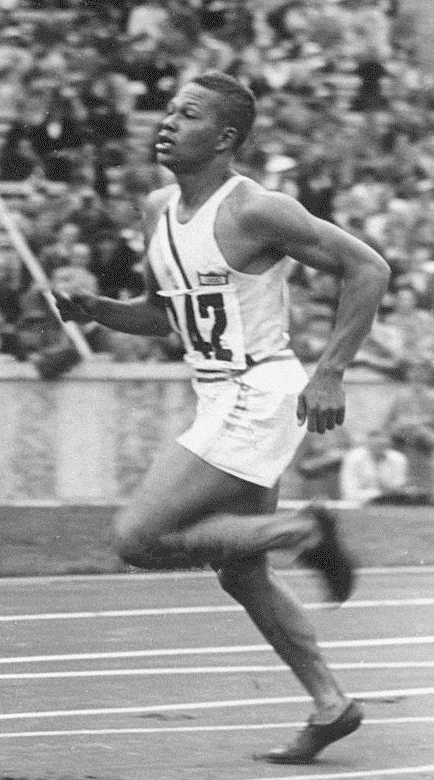 Loading image…
1915–1993
Archie Franklin Williams (May 1, 1915 – June 24, 1993) was an American U.S. Air Force officer, athlete, and teacher. He was the winner of the 400 meter run at the 1936 Summer Olympics.
1971
FROM THE SOURCE CATALOGCataloged as “"Archipelago": Kelvin Rotardier, Judith Jamison, Consuelo Atlas, & Dudley Williams” (Prints).
1932
FROM THE SOURCE CATALOGA black-and-red hardback copy of Architectural Graphic Standards owned and used by architect Julian Abele Cook, Sr. This hardback, first edition of Architectural Graphic Standards features black front and back covers with a red strip along the bound edge.…
mid-late 20th century
FROM THE SOURCE CATALOGArchitectural House Plan and Plumbing Template owned by John Chase. The tan template has black printed text and cut out areas in various shapes. The plastic is partially transparent and has rounded corners. There are sections labeled with dimensions…
mid-late 20th century
FROM THE SOURCE CATALOGArchitectural house template created by Timely Products Co. owned by John Chase. The tan template has black printed text and cut out areas in various shapes. The plastic is partially transparent. The object is labeled at the top [TIMELY / POST # 2970-T /…
2011
FROM THE SOURCE CATALOGArchitectural drawing of the new Student Center at the University of the District of Columbia (UDC) by architect Michael Marshall. This rendering is done in ink and watercolor on translucent paper. The drawing shows a colorful view of the new student…
before 1863
FROM THE SOURCE CATALOGA molding fragment from Charleston, South Carolina. The fragment is from a horizontal architectural element of a building. It has a cement body with a decorative plaster of Paris surface layer that is finished in gray paint. The back of the fragment is…
before 1863
FROM THE SOURCE CATALOGA molding fragment from Charleston, South Carolina. The fragment is from a horizontal architectural element of a building. The body is composed of a grayish portland cement with a decorative plaster of Paris surface layer that is finished in gray paint.…
before 1863
FROM THE SOURCE CATALOGA molding fragment from Charleston, South Carolina. The fragment is from a horizontal architectural element of a building. The fragment has a cement body. Above the cement is a thick decorative layer of an off-white portland cement, finished in a coat of…
before 1863
FROM THE SOURCE CATALOGA molding fragment from Charleston, South Carolina. The fragment is from a horizontal architectural element of a building. The fragment’s body is composed of cement. Above it is thick decorative layer that is finished in a coat of plaster with a lime wash.…
before 1863
FROM THE SOURCE CATALOGA molding fragment from Charleston, South Carolina. The fragment is from a horizontal architectural element of a building. The fragment’s body is composed of gypsum plaster. On the back of the fragment are three patches of tan stucco remnants on one side.…
before 1863
FROM THE SOURCE CATALOGA molding fragment from Charleston, South Carolina. The fragment is from a horizontal architectural element of a building. The fragment’s body is composed of cement. Above it is thick decorative layer that is finished in a coat of plaster with a lime wash.…
before 1863
FROM THE SOURCE CATALOGA molding fragment from Charleston, South Carolina. The fragment is from a horizontal architectural element of a building. The fragment’s body is composed of off-white cement. Approximately three-quarters of the back of the fragment is covered in stucco.…
before 1863
FROM THE SOURCE CATALOGA molding fragment from Charleston, South Carolina. The fragment is from a horizontal architectural element of a building. The fragment’s body is composed of two layers: cement at the back and plaster towards the decorative surface. There is a short metal…
before 1863
FROM THE SOURCE CATALOGA molding fragment from Charleston, South Carolina. The fragment is from a horizontal architectural element of a building. The fragment’s body is composed of two layers: light brown aggregate filler layer at the back and a white cementitious material…
before 1863
FROM THE SOURCE CATALOGA molding fragment from Charleston, South Carolina. The fragment is from a horizontal architectural element of a building. The fragment’s body is composed entirely of bright white plaster. The back of the fragment has several small patches of sandy beige…
Biographies, museum objects and archive records are distinct card types. Every card links to its historical source.