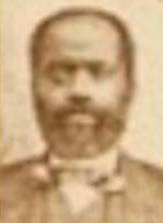
John Gloucester (1776 – 1822) was the first African American to become an ordained Presbyterian minister in the United States, and the founder of The First African Presbyterian Church at Girard Avenue and 42nd Street in Philadelphia, which had 123 members…
John Henry Murphy III (March 2, 1916 – October 16, 2010), was an American newspaper publisher and executive, head of the family-owned enterprise of the Afro-American newspaper based in Baltimore, Maryland. At its peak, it had nine national editions,…
John H. Paynter (1862–1947) was an African American writer of poetry and nonfiction who wrote the book Fugitives of the Pearl (1930), a popular history of the largest known mass escape attempt of enslaved people in the United States. The story was based on…
John Hannibal White (c. 1828 – July 26, 1878) was a delegate to South Carolina's 1868 Constitutional Convention, a two-term member of the South Carolina House of Representatives, and a state senator in South Carolina. He worked as a blacksmith. White was…
John Hendrick is an American college football coach and former professional player. He is the defensive coordinator at Hinds Community College, a position he has held since 2021. He is the former head football coach at Jackson State University in Jackson,…
John Henry Hale (June 5, 1878 – March 27, 1944) was a prominent surgeon, professor, and philanthropist who played a prominent role in establishing the black medical community. Hailed as the "dean of American Negro surgeons," Hale conducted over 30,000…
A black-and-white photograph of John Henry Self. He is wearing a baseball cap, a jacket and has a mustache. A lighted hallway can be seen in the background. The print is inscribed on the back.
Smithsonian National Museum of African American History and CultureCatalog 2012.41.21
John Hope (June 2, 1868 – February 22, 1936), born in Augusta, Georgia, was an American educator and political activist, the first African-descended president of both Morehouse College in 1906 and of Atlanta University in 1929, where he worked to develop…
A black-and-white gelatin silver print portrait of historian John Hope Franklin, survivor of the Tulsa Race Massacre. Franklin is depicted standing on N. Greenwood Ave. in Tulsa, Oklahoma, beneath the US-412 overpass. He wears a light colored suit jacket,…
Smithsonian National Museum of African American History and CultureCatalog 2014.206.10
John Hudson Riddick (April 1, 1848 – August 5, 1895) was an educator, community leader, and minister in the African Methodist Episcopal (AME) church. In 1872 he was elected a member of the Norfolk, Virginia, city council. He was an AME minister at a number…
The oral history consists of 2016.129.19.1a and 2016.129.19.2a: two versions (unedited, and edited) of a single digital video recording. John Jacob Oliver was interviewed as part of the NMAAHC Donor Oral History Collection. Mr. Oliver worked for the…
Smithsonian National Museum of African American History and CultureCatalog 2016.129.19.1a-.2a
John Jamison Moore (1818 – December 9, 1893), also known as J. J. Moore, was an American bishop of the AME Zion Church, journalist, church historian, and educator. Moore's achievements include writing a history of the AME Zion Church, establishing the…
John Johnson (May 28, 1879–1953) was an American photographer. His photographs are considered among the few documents of the early 20th-century African-American community in Lincoln, Nebraska.
John Robert Edward Kinard (November 22, 1936 – August 5, 1989) was an American social activist, pastor, and museum director. He is best known as the director of the Anacostia Museum, a small community museum founded by the Smithsonian Institution in 1967.…
John L. McKinley was an American college football coach. He served as the head football coach at the State College for Colored Students—now known as Delaware State University—in Dover, Delaware for one season, in 1931. McKinley graduated from Armstrong…
John Lay Thompson (April 3, 1869, Grand River Township, Decatur County, Iowa – 1930) was an Iowa journalist and businessman who played a key role in the early history of the African American newspaper the Iowa Bystander. Thompson was born to Andy and…
A fifth edition of John L. Webb's Manual of the Court of the Heroines of Jericho. The small, hardcover book has a solid blue cover with gilt text. An inscription on front endpaper reads, [this Book Property of / Rev. HC Anderson]. The book has 95 total…
Smithsonian National Museum of African American History and CultureCatalog 2007.1.48
A black-and-white digital image of a close-up of John Lewis and Sister Mary Leoline holding hands. Lewis stands on the left, wearing a light colored trench coat with a white lei. Sister Mary stands in the middle, wearing a nun's habit with a large silver…
Smithsonian National Museum of African American History and CultureCatalog 2015.129.48
John Mifflin Brown (September 8, 1817 – March 16, 1893) was a bishop in the African Methodist Episcopal (AME) Church. He was a leader in the Underground Railroad. He helped open a number of churches and schools, including the Payne Institute which became…
John Marrant (June 15, 1755 – April 15, 1791) was an American Methodist preacher and missionary and one of the first black preachers in North America. Born free in New York City, he moved as a child with his family to Charleston, South Carolina. His father…
John Merrick (1859–1919) was an American businessman. Born into slavery in Clinton, North Carolina, Merrick founded various companies in the Raleigh, North Carolina and Durham, North Carolina areas, most notably the North Carolina Mutual Life Insurance…
John Newton Templeton (c. 1807 – July 1851) was born into slavery in about 1807, and after being emancipated with his family, he received a classical education and became a teacher in a number of schools for African Americans.
John Noland (c. 1844 – June 25, 1908) was a slave and the personal servant of bushwhacker William C. Quantrill during the American Civil War. Noland was a chattel slave owned by Francis Asbury Noland in Jackson County, Missouri.

 Loading image…