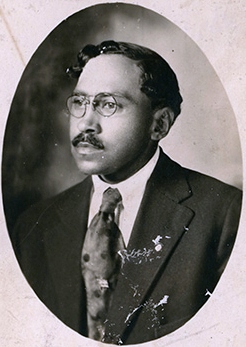
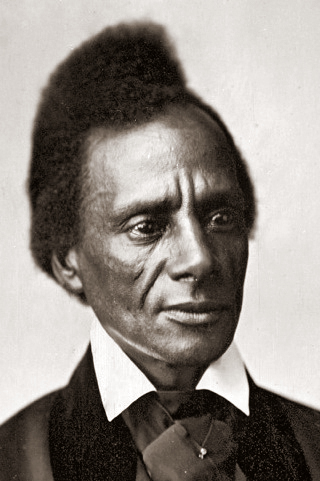
Cesar Chelor (born in Wrentham, Massachusetts) was an African-American woodworker, toolmaker, plane-maker and was enslaved by the colonial entrepreneur and the earliest documented American plane maker Francis Nicholson (1683–1753). Chelor is the earliest…
Cesar Picton (c. 1755 – 1836) was a British merchant of West African descent. Born in West Africa, he was presumably enslaved by the time he was about six years old. He was subsequently brought to England by a British Army officer in 1761 and given as a…
Wood frame chair with arms and a high back with ornately carved decorative elements. The chair is upholstered with velvet seat cushion, arm pads, and square backing. The front legs have two small swivel castors.
Smithsonian National Museum of African American History and CultureCatalog 2016.104.7
Wood frame chair with arms and a high back with ornately carved decorative elements. The chair is upholstered with velvet seat cushion, arm pads, and square backing. The front legs have two small swivel castors.
Smithsonian National Museum of African American History and CultureCatalog 2016.104.8
Charity Still (c. 1765 – 1857) was an American abolitionist, and the matriarch of the American abolition movement. Her son William Still became a well-known abolitionist in Philadelphia, Pennsylvania; her children Peter, James, John, and Mary played roles…
Charles and Bettie Birthright were an African American married couple who lived in Clarkton, Dunklin County, Missouri, United States, who became philanthropists. Born into slavery and freed after the Civil War, they became landowners and community figures…
Charles Ball (real name Charles Gross; c. 1780 – unknown) was an enslaved African American from Maryland, best known for his account as a fugitive slave, Slavery in the United States (1836).
Charles Bennett Ray (December 25, 1807 – August 15, 1886) was a prominent African-American minister and abolitionist who owned and edited the weekly newspaper The Colored American. Born in Massachusetts, he spent most of his career and life in New York City.
Dr. Charles Burleigh Purvis (April 14, 1842 – December 14, 1929) was an African-American physician who resided in Washington, D.C. Among the founders of the medical school at Howard University, he was the first African-American physician to attend a…
Charles Caldwell (1830 or 1831 – December 30, 1875) was a Reconstruction era political and state militia leader in Mississippi. He held office as a state senator and county commissioner before being assassinated in 1875. A former slave, he was a delegate…
Charles Franklin Moss (1878-1961) was an African American photographer and painter born in Winchester, Virginia. Moss' mother was born into slavery and his father was a mason. He showed interest in art early in his life and attended Cooper Union and the…
Charles Henry Langston (1817–1892) was an American abolitionist and political activist who was active in Ohio and later in Kansas, during and after the American Civil War, where he worked for black suffrage and other civil rights. He was a spokesman for…
Charles Hicks Bustill (c.1815–1890) was an African-American abolitionist and conductor in the Underground Railroad in Philadelphia before the American Civil War. He made a living as a plasterer. Bustill's grandfather was Cyrus Bustill and he was a member…
Charles Lenox Remond (February 1, 1810 – December 22, 1873) was an American orator, activist and abolitionist based in Massachusetts. He lectured against slavery across the Northeast, and in 1840 traveled to the British Isles on a tour with William Lloyd…
Charles Reese was a state legislator in Mississippi. He represented Hinds County, Mississippi in the Mississippi House of Representatives in 1872 to 1873. In April 1872 he signed, along with many representatives and senators, a petition for the equal…
Charles Samuel Green was a farmer and state legislator in South Carolina. He represented Georgetown County, South Carolina, and was first elected as a representative in October 1872. Green was born enslaved in Georgetown County. He served in the South…
This is a square metal slave badge with clipped corners. On the recto is text that reads ”C . N [punched]” across the top. Under that is “PORTER [punched] / 1848 [punched] / 230 [punched].” There is a hole punched at the proper right top corner. There is a…
Smithsonian National Museum of African American History and CultureCatalog 2022.5.98
This is a square metal slave badge with clipped corners. On the recto is text that reads ”C . N [punched]” across the top. Under that is “PORTER [punched] / 1848 [punched] / 70 [punched].” There is a cut on the proper right edge running towards the date.…
Smithsonian National Museum of African American History and CultureCatalog 2022.5.97
A square copper slave badge with clipped corners with hand punched text on the recto reading: "C.N / PORTER / 1848 / 74". A hole is punched through the left facing top corner.
Smithsonian National Museum of African American History and CultureCatalog 2016.166.31.2
This is a square metal slave badge with clipped corners. On the recto is text that reads” C . N [punched]” across the top. Under that is “SERVANT [punched] / 1848 [punched] / 433 [punched].” There is a hole punched at the proper left top corner.
Smithsonian National Museum of African American History and CultureCatalog 2022.5.96
This is a square metal slave badge set on point with clipped corners. On the recto is text that reads ”CHARLESTON [stamped] / NECK [stamped]” across the top. Under that is “277 [punched] / PORTER [stamped] / 1849 [stamped].” There is a hole punched at the…
Smithsonian National Museum of African American History and CultureCatalog 2022.5.101
This is a square metal slave badge set on point with clipped corners. On the recto is text that reads ”CHARLESTON [stamped] / NECK [stamped]” across the top. Under that is “184 [punched] / SERVANT [stamped] / 1849 [stamped].” There is a hole punched at the…
Smithsonian National Museum of African American History and CultureCatalog 2022.5.100
This is an octagonal metal slave badge. On the recto is text “No 14 [engraved] / FISHER [stamped] /1800 [stamped].” On the verso is a stamped cartouche at the top center with the maker's name “ATMAR.” There is a hole punched at the center top. Proper right…
Smithsonian National Museum of African American History and CultureCatalog 2022.5.1