Carte-de-visite of a group of African Americans gathered around a man with a pocket watch, leaning on a pulpit made out of U.S. Sanitation Commission crates. A sign on the wall reads "1 Jan-Slaves Forever Free." The text in chain links on the sides read…
Smithsonian National Museum of African American History and CultureCatalog 2010.77.7
Wallace Aaron Battle (1872–1946) was an educational leader for African Americans in the Southern United States. He grew up on a cotton farm in Alabama with the other 12 children of Augustus and Jeanetta (Redden) Battle, freed slaves. Battle graduated from…
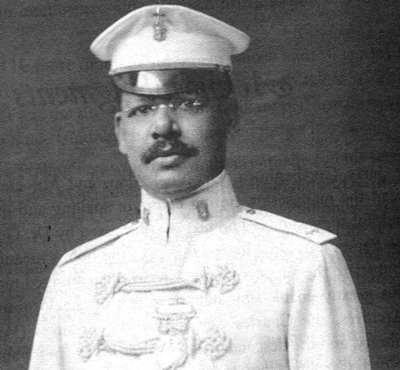
Walter Howard Loving (December 17, 1872 – February/March 1945) was an African American soldier and musician most noted for his leadership of the Philippine Constabulary Band. The son of a former slave, Loving led the band during the 1909 U.S. presidential…
Albumen print stereograph titled: [Camp Dinner--War Views--Army of the Potomac No. 2056.] with two identical photographs of four white men seated around the table eating a meal and a Black man seated on the ground next to the makeshift table. Three of the…
Smithsonian National Museum of African American History and CultureCatalog 2018.105.8
A warrant handwritten in brown ink on a single sheet of folded off-white paper calling for the creation of a slave patrol in Loudon County, Virginia. The warrant is addressed to a group of men and the main text reads "Whereas information has been given to…
Smithsonian National Museum of African American History and CultureCatalog 2020.21.3
Unbound warrants issued in response to freedmen's complaints cover the period January–December 1866. Those covering the period January–December 1866 are arranged by initial letter of the surname. Warrants covering the period January–September 1866 are…
Smithsonian National Museum of African American History and CultureCatalog NMAAHC.FB.M1904, File 4.20.19
Warren Clay Coleman (May 25, 1849 – May 24, 1904) was an African-American businessman in south-central North Carolina known as a founder of the Coleman Manufacturing Company, which built one of the first black-owned and operated textile mills in the United…
An elongated brick, or “double brick,” made by an enslaved person. The brick comes from the north-east cistern on the lawn of the Old Warren County Courthouse, Vicksburg, Mississippi. It is a solid style, extruded brick. The rectangular brick is dark…
Smithsonian National Museum of African American History and CultureCatalog 2017.108.21.18
This pot belonged to and was used by Manda (Amanda) Caldwell and her daughter Susie (Susan) Caldwell McGill. Manda Caldwell was born enslaved in the York County or Cherokee County areas of South Carolina. She worked as a laundress during and after her…
Smithsonian National Museum of African American History and CultureCatalog 2013.161
A rectangular wooden washboard with metal scrubbing rods. The top of the washboard has green paint on parts of it and a large crack running diagonally across it. A knothole is on the right side. The twenty-five (25) scrubbing rods are attached to the…
Smithsonian National Museum of African American History and CultureCatalog 2017.108.25.1
A watch fob owned by Lew Snowden. The fob is made of twenty-one (21) ivory beads and a metal “T” shaped clasp on a leather cord. The beads are different shapes and sizes. Each bead has a geometric pattern incised on it.
Smithsonian National Museum of African American History and CultureCatalog 2024.65.2
Weary D. Clyburn (1841–1930) was an American slave who was a body servant to a Confederate States Army officer during the American Civil War. Despite the fact that African-Americans were not permitted to serve in the Confederate military, Clyburn is…
Maroon envelope that held gold sleeve [2018.30.1g] and wedding invitation [2018.30.1e] designed by Hadiya Williams for the wedding of Shantrelle Lewis and Oluwatoyin Lawson. On the back rectangular flap is a circular, gold ink stamp. The inner circle has a…
Smithsonian National Museum of African American History and CultureCatalog 2018.30.1f
A wedge-arm sash fillister plane. Body, arms, and blade wedge are wood. Wooden sole is attached to body using sliding dovetails. On short end of the body, vertically in relief, is [CE CHELOR / LIVING IN / WRENTHAM]. There are cracks on the stock. There is…
Smithsonian National Museum of African American History and CultureCatalog 2023.8.5
A yellow and black jasperware dish by Wedgwood, released in 1983 in commemoration of the 150th anniversary of the abolition of slavery in Great Britain. The circular dish is light yellow ceramic with a relief cameo of the Wedgwood antislavery medallion at…
Smithsonian National Museum of African American History and CultureCatalog 2023.89.3
Unbound weekly and monthly reports of sick and wounded, August 1864–May 1869, are arranged by type of report and thereunder chronologically. Included are both reports from surgeons and copies of the chief medical officer's reports sent to Washington.
Smithsonian National Museum of African American History and CultureCatalog NMAAHC.FB.M1905, File 3.2.4