Pernella Mae Center Anderson (1903–1980) was an African American interviewer for the Federal Writers' Project. She was from El Dorado, Arkansas. She was the only African American woman in Arkansas to interview former slaves.
Perry Wilbon Howard (c. 1835–1907) was an American blacksmith, and a state legislator in Mississippi. He represented Holmes County, Mississippi in the Mississippi House of Representatives from 1872 to 1875; and served on the county board of supervisors. He…
The "Personal Reports," November–December 1866, are arranged chronologically. They consist of notifications sent to the Assistant Commissioner by officers and agents informing him that they were on duty.
Smithsonian National Museum of African American History and CultureCatalog NMAAHC.FB.M979, File 2.5.4
Peter Anderson (c. 1822–1879) was an African American newspaper publisher and activist who actively participated in California State Colored Conventions during the 1800s. Anderson was also co-founded the newspaper called the Pacific Appeal (1862–1880),…
Peter Barnabas Barrow (died 1906) was a slave, soldier, state legislator, and minister in the United States. He served in the Mississippi Senate, and Mississippi House of Representatives 1870-1871. A photo of him is part of the Mississippi State University…
Peter Durrett (c. 1733–1823) (also appeared in records as Peter Duerrett) was an enslaved Baptist preacher, who with his wife founded the First African Baptist Church of Lexington, Kentucky, by 1790. By his death, the congregation totaled nearly 300…
Peter Farley Fossett (June 5, 1815 – January 3, 1901) was an enslaved laborer at Monticello, Thomas Jefferson's plantation, who after he attained his freedom in the mid-19th century, settled in Cincinnati where he established himself as a minister and…
Peter Humphries Clark (March 29, 1829 – June 21, 1925) was an American abolitionist and speaker. One of Ohio's most effective black abolitionist writers and speakers, he became the first teacher engaged by the Cincinnati black public schools in 1849, and…
Peter Hill (July 19, 1767 – December 1820) was an American clockmaker. Hill, a former enslaved person, was the first African American clockmaker and the only African American clockmaker working during the late eighteenth century and early nineteenth…
Peter Lester (c. 1814 – c. 1897) was an American-born 19th-century businessman and abolitionist. He was an early Black settler in San Francisco. In February 1860, he was the first Black person to sit as a juror in British Columbia.
Peter Quire (June 15, 1806–May 5, 1899) was an American abolitionist, community leader, cobbler, and church founder. He was a member of the Underground Railroad in Philadelphia, Pennsylvania as a child; and later with his wife Harriet, he was a founder of…
Rev. Peter Randolph (c. 1825 – August 7, 1897) was an African-American minister and abolitionist. Born into slavery in Virginia, he was freed in the will of his owner but this request took three years and legal proceedings to be honored. Randolph moved to…
Private Peter Salem (October 1, 1750 – August 16, 1816) was an American soldier who served in the Continental Army during the American Revolutionary War. Born into slavery in Framingham, Massachusetts, he was manumitted by one of his enslavers, Major…
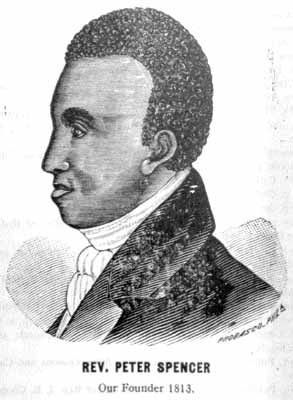
Peter Spencer (1782–1843) was an American freedman who in 1813 founded the Union Church of Africans in Wilmington, Delaware. The denomination is now known as the African Union First Colored Methodist Protestant Church and Connection, or A.U.M.P. Church for…
Peter Still (February 22, 1801 – January 10, 1868), was an American former slave, who secured his own freedom in 1850 and subsequently collected enough money to purchase the freedom of his wife and three children in 1854. His efforts were documented in the…
Peter Thomas Stanford (February 21, 1858 – May 20, 1909) was an African American religious minister and writer, born enslaved near Hampton, Virginia. His enslavers orphaned him after selling both of his parents to other plantations before he had turned…
Rev. Peter William Cassey (1831–1917) was an African-American 19th-century school founder, deacon, minister, educator, abolitionist, and political activist. He was a pioneer in Santa Clara County.
Peter Williams Jr. (1786–1840) was an African-American Episcopal priest, the second ordained in the United States and the first to serve in New York City. He was an abolitionist who also supported free black emigration to Haiti, the black republic that had…