Nathaniel Wells (10 September 1779 – 13 May 1852) was a British planter and politician of Afro-Caribbean descent. Born on a slave plantation in Saint Kitts, he was sent to Britain to complete his education, eventually serving as a magistrate after being…
A copy of the National Anti-Slavery Standard newspaper, Volume 20, Number 19. The newspaper is printed on off white newsprint with black ink. Printed in large ornate text on the masthead is “National Anti-Slavery Standard.” The volume number, date and…
Smithsonian National Museum of African American History and CultureCatalog 2010.1.298.34
A carved wooden neck yoke. The yoke beam is carved from a single piece of stained wood. The yoke is thick in the middle with tapered sides and ends. At the center of the yoke beam is a carved out semicircle for the neck rest. The underside of the yoke has…
Smithsonian National Museum of African American History and CultureCatalog 2017.108.23.87
This neckerchief was worn by Chiwetel Ejiofor as Solomon Northup in the film 12 Years a Slave (2013). The neckerchief is merely a strip of printed cotton cloth with all of the edges cut raw and slightly unraveled. The fabric has a design of medium scale…
Smithsonian National Museum of African American History and CultureCatalog 2015.158.2.4
Nedra "NedRa" Bonds (born 1948) is an American quilter, activist, and retired teacher, born and raised in the historic Quindaro neighborhood in Kansas City, Kansas. Bonds creates quilts and mixed media fiber dolls using fabric, beads, and symbolism to…
A framed needlepoint reproduction of Eva's Forebodings, an illustrated plate from Harriet Beecher Stowe's “Uncle Tom's Cabin.” The needlepoint depicts Uncle Tom and Eva St. Clare seated by a river. There is a sailboat on the right side of the needlepoint…
Smithsonian National Museum of African American History and CultureCatalog 2011.12.35
A 392-page hard bound book entitled Negroes in Brazil: A study of Race Contact at Bahia by Donald Pierson. The cover is green with yellow text and graphics. The cover shows an outline of a map of South America with all countries except for Brazil filled in…
Smithsonian National Museum of African American History and CultureCatalog 2010.1.247
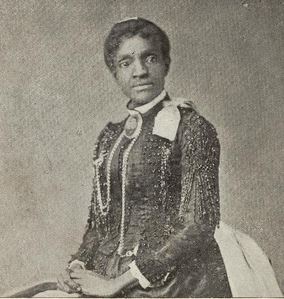
Nellie Arnold Plummer (September 7, 1860 to 1933) was a former slave who became the first female student to attend the Normal Department of Wayland Seminary in Washington, D.C. She subsequently worked as a teacher for over forty-five years and published…
Nellie Murray (c. 1835-1918) was a caterer specializing in Creole cuisine who was born in a family held as slaves in New Orleans and became internationally recognized after her appearance cooking at the 1893 Chicago World Fair.
Nellie A. Ramsey Leslie (better known as N.A.R. Leslie; née Coles; c. 1840s-c. 1920s) was notable as a teacher, musician and composer, working in Louisiana and Mississippi, and then in Indian Territory and Corpus Christi, Texas, where she founded a musical…
Nelson Walker (c. 1827 - July 7, 1875) was a community leader in Tennessee and Justice of the Peace. He was born enslaved, worked as a barber, purchased freedom for himself, his wife, and their four children, and became a wealthy lawyer, judge and bank…
Neptune Small (September 15, 1831 – August 10, 1907) was a slave of the Thomas Butler King family at Retreat Plantation, St. Simons Island, Georgia. He accompanied Captain Henry Lord Page King during the Civil War until King's death in battle on December…
Nero Hawley (1742 – January 30, 1817) was an African-American soldier who was born into slavery in North Stratford, Connecticut, and later earned his freedom after enlisting in the Continental Army in place of his owner, Daniel Hawley, on April 20, 1777,…
Patrick Campbell’s painting, with its bold stripes featuring bodies hanging from nooses, and cracked stars with people falling, pleading, or wielding weapons in between, went viral in December 2014. Earlier that month, a New York grand jury ruled “no…
Smithsonian National Museum of African American History and CultureCatalog 2015.99
A broadside of the New England Loyal Publication Society, consisting of a single sheet of white wove rag paper with printed black ink on one side only. The top right corner has undergone a prior repair.The header across the top reads [No. 147 / NEW ENGLAND…
Smithsonian National Museum of African American History and CultureCatalog 2019.26.10
An edition of the weekly New-York Mirror. Subheadings at top of page read [A Weekly Journal, Devoted to Literature and the Fine Arts. Embellished with Fine Engravings, and Musid arranged with accompaniments for the Pianoforte.] Newspaper includes book…
Smithsonian National Museum of African American History and CultureCatalog 2014.312.239
Issue Vol. 2 No. 22 of the New York Weekly Messenger. Black type on off-white paper. On interior page at leftmost column is an account by Captain Benjamin Morrell Jr., [CAPT. MORRELL'S VISIT TO A SLAVE SHIP], on his inspection of Brazilian slave ships in…
Smithsonian National Museum of African American History and CultureCatalog 2014.312.229
Issue of Newark Daily Advertiser Vol. 8 No. 176 from January 27th, 1840. On page two, column four, there is a brief update on United States v. Schooner Amistad. At the top of column five is a letter from Rev. John Pinney, of Monrovia, concerning the…
Smithsonian National Museum of African American History and CultureCatalog 2014.312.230
Issue of Newark Daily Advertiser Vol. XXVII No. 207 published on September 8, 1858. Black ink on brittle, discolored paper. On second page is an article entitled "The Captured Blacks--Their Distressing Condition" about the arrival of a slave ship at port…
Smithsonian National Museum of African American History and CultureCatalog 2014.312.231
A page from the New York Daily Tribune reporting on the violence occuring in the Kansas territory. Highlights have been noted by someone with red pen. Included in the reporting is the death of David Hoyt.
Smithsonian National Museum of African American History and CultureCatalog 2011.23.3
A clipping from The Philadelphia Tribune featuring a reproduction of John G. Darby's woodcut engraving portrait of Harriet Tubman. The image has been cropped from the original full-length portrait which depicts Tubman standing, holding a rifle with Civil…
Smithsonian National Museum of African American History and CultureCatalog 2009.50.12
Two article clippings with an engraved color image. The article (a) describes, from the Western European perspective of Presbyterian missionary, Hugh Goldie, the funeral ceremonies, termed "Devil-making," for the late King Eyamba. One clipping (b) depicts…
Smithsonian National Museum of African American History and CultureCatalog 2018.46.8.5abc
Newton Isaac Collins Sr. (February 11, 1826 – September 7, 1903) was an African-American freedman from Alabama who moved to Travis County, Texas, in the 1840s, where he was re-enslaved. After the Emancipation Proclamation, Collins again received his…
Francisca de Paula de Jesus (São João del-Rei, Minas Gerais, 1810 – Baependi, Minas Gerais, 14 June 1895), also known as Nhá Chica ("Aunt Francie" in Portuguese), was a formerly enslaved Afro-Brazilian Catholic laywoman known for her humble life and her…