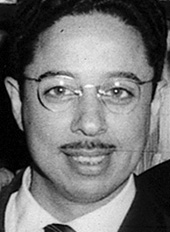
Sir Horace Shango Ové (born Horace Courtenay Jones; 3 December 1936 – 16 September 2023) was a Trinidadian-born British filmmaker, photographer, painter and writer based in London, England. One of the leading black independent filmmakers to emerge in…
Horace Roscoe Cayton Jr. (April 12, 1903 – January 21, 1970) was a prominent American sociologist, newspaper columnist, and writer who specialized in studies of working-class black Americans, particularly in mid-20th-century Chicago. Cayton is best…
A black-and-white photograph of jazz musician and composer Horace Silver playing piano during a performance in Miami, FL. Silver is photographed from a low angle and slightly behind and to the right. The image is mostly in shadow with Silver's face and…
Smithsonian National Museum of African American History and CultureCatalog 2012.164.122
Horacio Adolfo Salgán (June 15, 1916 – August 19, 2016) was an Argentine tango musician. He was born in Buenos Aires to an established Afro-Argentine family. Some of Salgán's most well-known compositions include Del 1 al 5 (Días de pago) (1944), A Don…
A Cerwin-Vega horn speaker. The speaker front is rectangular in shape and painted orange. The sides of the front concave in towards the middle to create a cone shape. The front also has a bar in the middle of the speaker that splits it into two chambers.…
Smithsonian National Museum of African American History and CultureCatalog 2012.47.11.1
A Cerwin-Vega horn speaker. The speaker front is rectangular in shape and painted orange. The sides of the front concave in towards the middle to create a cone shape. The front also has a bar in the middle of the speaker that splits it into two chambers.…
Smithsonian National Museum of African American History and CultureCatalog 2012.47.11.2
A Cerwin-Vega horn speaker. The speaker front is rectangular in shape and painted black. The sides of the front concave in towards the middle to create a cone shape. The front has three slats so that the horn has four separate chambers. The back of the…
Smithsonian National Museum of African American History and CultureCatalog 2012.47.11.3
The fact that only four horses could be mustered on this occasion demonstrates the great decline in horse keeping in Ilorin, which is reflected in the equally great decline in the numbers of leatherworkers in the twentieth century.
Smithsonian Eliot Elisofon Photographic Archives, National Museum of African ArtCatalog EEPA.2016-004, Item EEPA 2016-004-0014
Cataloged as “Horse Motif Painted on Wall of Title House Wall Paintings, Atsogwa Title Ceremony, Idogu's Compound, Afokpella, Okpella, Etsako, Edo State, Nigeria” (Slides (photographs)).
Smithsonian Eliot Elisofon Photographic Archives, National Museum of African ArtCatalog EEPA.2016-007, Item EEPA 2016-007-1184
Horses Ass - Parade Duty, Broadway, Manhattan, New York, 1930's Joe Schwartz, Folk Photography: Poems I've Never Written (2000), 29. A black-and-white photograph of a mounted police officer patrolling a parade route. On the verso is an inscription reading…
Smithsonian National Museum of African American History and CultureCatalog 2010.74.31
A horse saddle used by Ernest Robinson. It has two stirrups toward the front. Each stirrup is covered in leather where the foot rests. Each side has a leather fender covering the belted portion of the stirrup and hobble strap. The saddle horn has a small…
Smithsonian National Museum of African American History and CultureCatalog 2014.21